
Curate
AI fitness for the life you actually have.
Role: Product Designer · Type: Concept Project · Duration: 4 Weeks
OVERVIEW
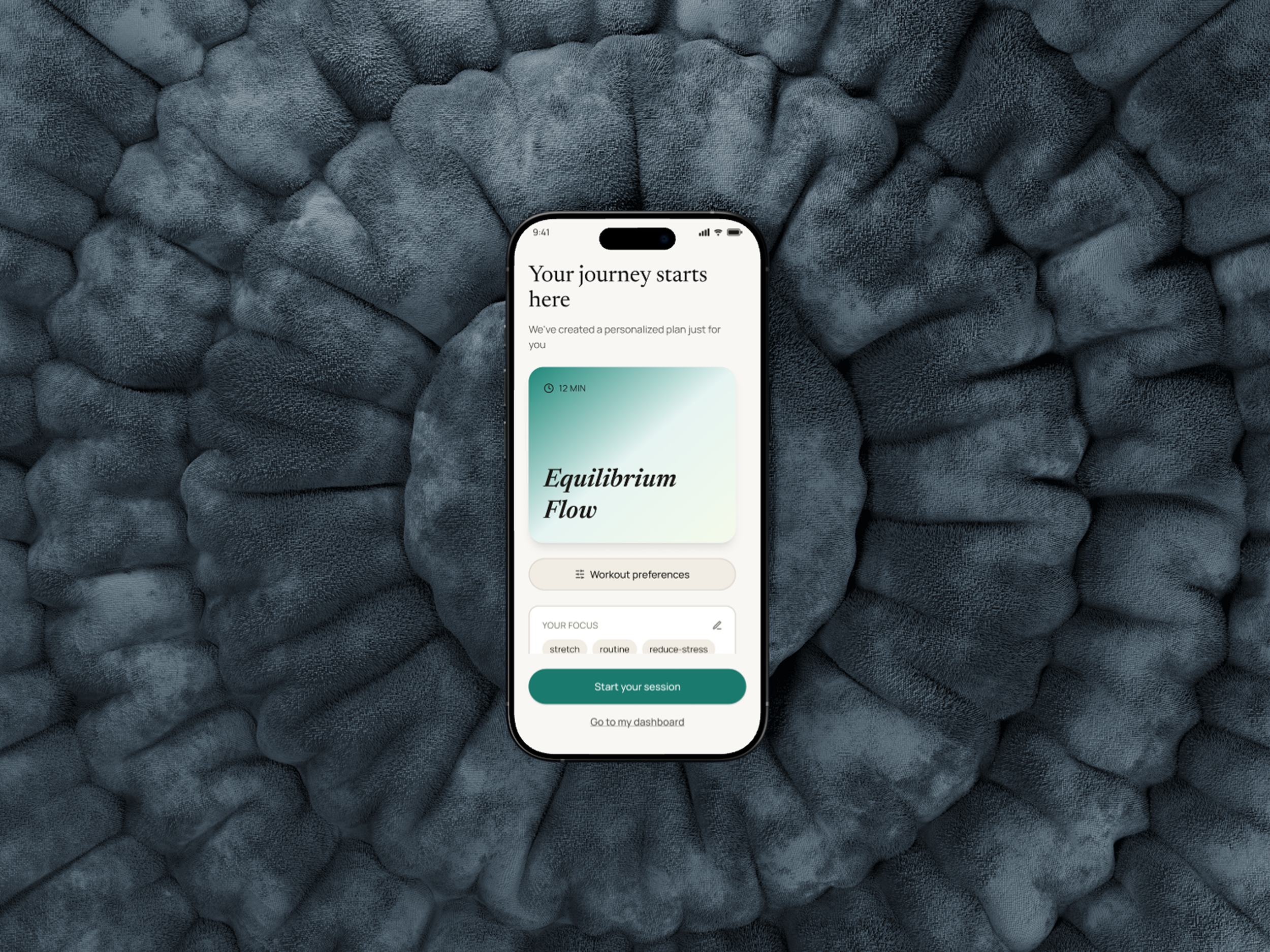
Curate is a concept fitness app designed specifically for the lapsed user — someone who didn't abandon their fitness journey from lack of motivation, but because traditional apps made them feel micromanaged, watched, and guilty for missing a single day.
To address this friction directly, I designed the product around three core UX pillars:
Zero-Decision Onboarding: Remove the barrier to a first session entirely. The AI learns from behavior, not from a form.
Shame-Free Tracking: Replace streak counters with a progress model that treats an irregular week as data, not defeat.
Adaptive AI Coaching: A warm coach that adjusts to how you're actually feeling today, not to a schedule you set last Monday.
ROLES + RESPONSIBILITIES
ROLE
DURATION
RESPONSIBILITIES
BREAKPOINT
TOOLS
Product Designer
4 Weeks
Competitive Analysis · Persona Development · Customer Journey Mapping · Brand Identity · Voice & Microcopy · UX Strategy · Interaction Design · AI Collaboration
Mobile
Figma · Claude · ChatGPT · Perplexity · Consensus · Stitch · Gemini · Gamma
THE PROBLEM
A design problem, not a motivation problem.
Streak counters, declining progress charts, and guilt-driven re-engagement notifications all send the same message: missing a day is failure. 22.9% of people who download a health app stop using it — and shame-driven dropout is a reason why. The competitors know retention is broken. They keep building the same architecture anyway.
The gap in the market wasn't a missing feature. It was a missing philosophy — one that treats irregular weeks as normal user behavior, not as something to correct.
MY APPROACH
One belief. Every decision traced back to it.
Before any design work began, one central philosophy shaped the entire project: lower the cost of showing up for a user who already expects the app to fail them.
Instead of demanding consistency from a skeptical user, the experience had to earn their trust first. Four principles gave that belief structure:
Design for Reality, Not the Perfect Interface: Traditional retention models fail because they're designed for a consistency they can't guarantee.
Shame Drives Dropouts: Shame is a primary dropout driver, not a motivator. Progress loops had to reward flexibility instead.
AI Should Reduce Decisions: Every AI touchpoint was evaluated against one question— does this reduce friction, or add to it?
Earning Trust Through Words and Visuals: For this positioning to land, trust had to be built at the copy level, not just the UI level.
With these principles established, AI was embedded into the process as a thinking partner for pressure-testing assumptions, surfacing blind spots, and accelerating synthesis. This freed the working sessions for the decisions that required human judgment and oversight.
RESEARCH
One empty quadrant. Every competitor missed it.
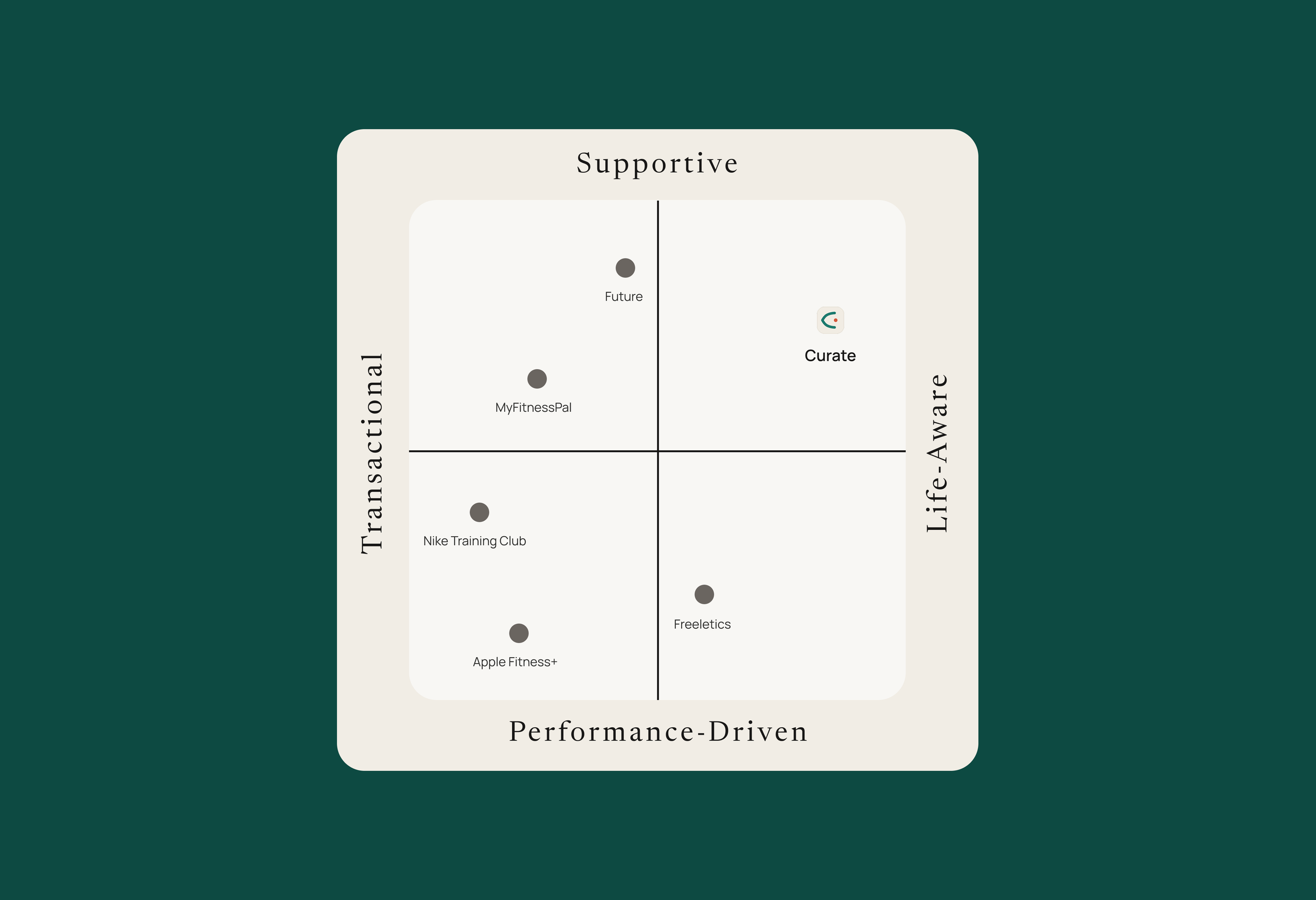
A competitive analysis across five competitors — Nike Training Club, Apple Fitness+, Freeletics, MyFitnessPal, and Future — revealed a consistent pattern: every app clusters in the performance-driven, transactional quadrant. Supportive and life-aware was wide open.
The research also surfaced a structural insight about why incumbents stay where they are. Performance metrics are easier to design for. Shame-free progress architecture requires the product to hold a different belief about users — and most products aren't built to hold beliefs.
INSIGHTS
01
Onboarding complexity is the primary dropout driver for first-time users — not lack of motivation.
02
Progress framing that treats variability as failure compounds dropout rather than preventing it.
03
AI coaching optimized for performance metrics fails the users who need an adaptive coach most — the ones whose capacity varies day to day.
USER PERSONAS
Six personas. One primary lens.
The research surfaced six distinct personas spanning the core user segments — from first-time fitness app users navigating decision paralysis to experienced users who've abandoned multiple platforms for reasons that never made it into the app's analytics.
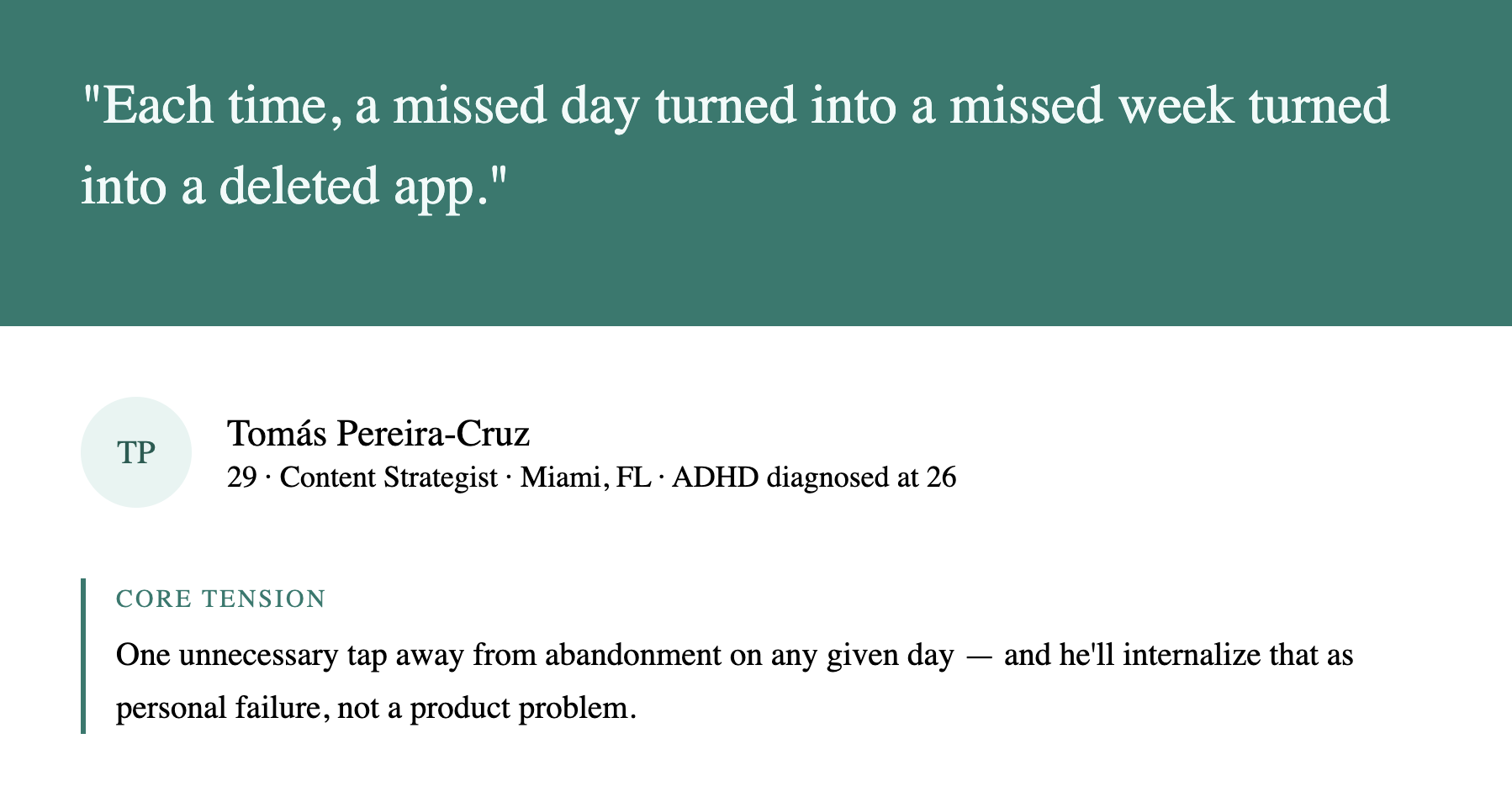
Tomás Pereira-Cruz became the primary generative persona. 29, content strategist, Miami. Recently diagnosed with ADHD. Has abandoned four fitness apps in two years — not because he stopped wanting to move, but because each one eventually made him feel watched and behind for missing a day. Every design decision was filtered through one question: would this work for Tomás on a Tuesday night when his energy is low, and his patience is lower?
UX JOURNEY + OPPORTUNITIES
Mapping Tomás's journey across five stages — Awareness, Consideration, Onboarding, Core Use, and Retention — identified where existing products lose users and why. Three opportunities emerged, each tied to a specific moment of failure that no competitor had closed.
Three opportunities. Each one a failure mode no competitor had fixed.
01
Zero-Decision Onboarding
Reduce the path from download to first session to under 90 seconds and one decision. The AI learns from the first movement — not from a form.
02
Shame-Free Progress
Replace streak counters and declining charts with a progress model that treats an irregular week as data, not defeat.
03
Warm Coach AI
Every competitor optimizes AI for performance metrics. Curate's AI is optimized for how you feel at 9 pm on a Tuesday — adapting session intensity to real life, not to a schedule.
BRAND + IDENTITY
A brand built from the positioning up.
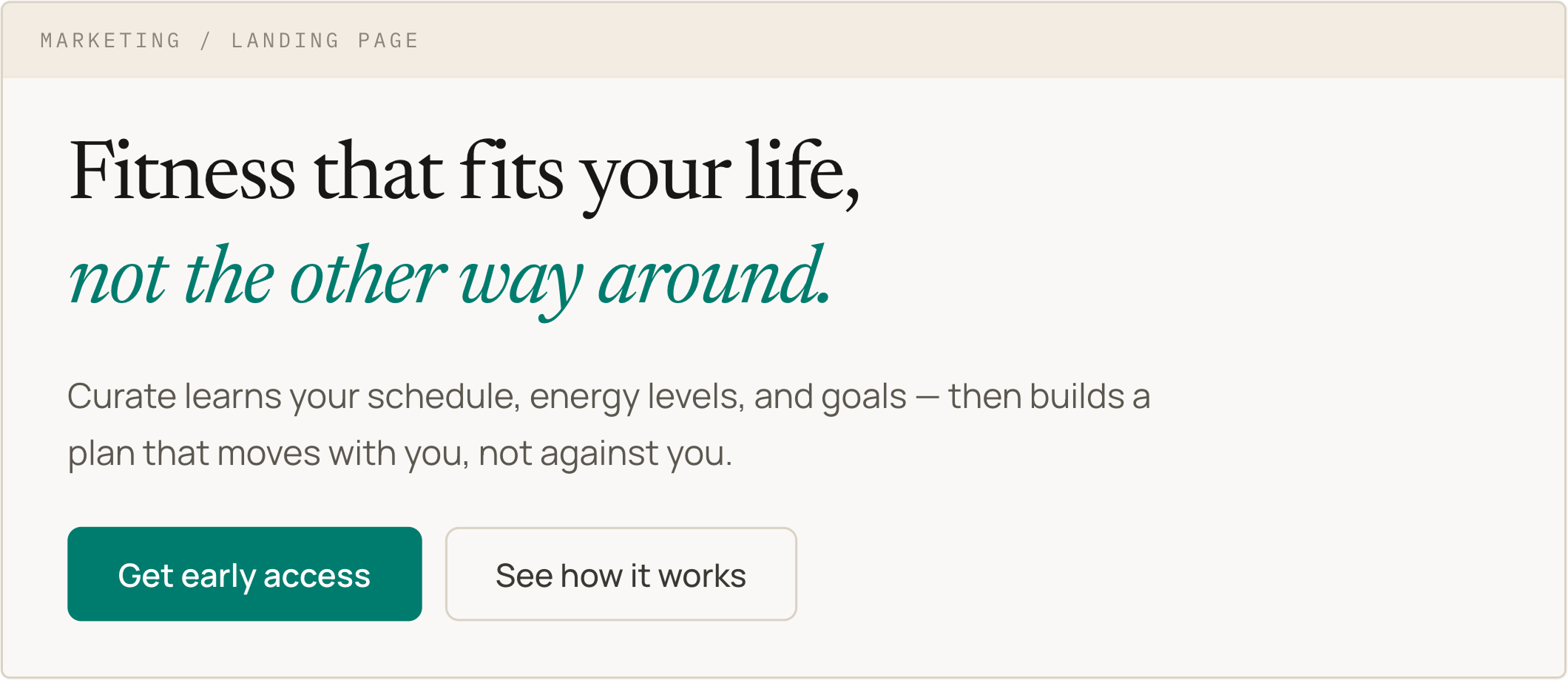
The name came directly from the product strategy. To curate is to select, organize, and present with care on behalf of someone you understand deeply. That's the product's relationship to the user in a single word.
To protect this positioning, the identity deliberately rejects standard industry tropes — no fitness clichés, no performance language, no implied judgment about where someone is starting from.
The full brand system was built to carry that philosophy across three layers:
Voice: A voice system with explicit guardrails against shame-driven microcopy. Every touchpoint is written to validate effort, not penalize absence.
Visual: A Teal, Coral, and Indigo palette designed for warmth and WCAG 2.2 compliance across light and dark modes.
Tagline: A single line that splits user autonomy from AI support cleanly: Move at your pace. We've got the rest.
UX + PROTOTYPE
Five screens. First session in under 90 seconds.
Every onboarding question asked before a user actually experiences the product is just an invitation to close the app and delete it. For an audience that has already abandoned traditional fitness apps, that friction is lethal.
To solve for that friction directly, I prototyped a zero-decision onboarding flow to get out of the user's way and get them moving inside a curated workout session within 60 seconds. Rather than making people fill out diagnostic forms, the interface lets the AI infer preferences from behavior over time.
Stress-testing this initial three-screen flow against an accessibility-focused lens exposed exactly where the experience felt too rigid, forcing a few key iterations:
The Energy Deficit: Early testing showed that for users with chronic conditions or variable energy, a static profile isn't enough. They needed to feel seen when they started their onboarding. I introduced a simple three-option energy check-in — each paired with a session preview. It added minimal friction but gave the user immediate agency and the AI its first real signal.
Screen Reader Failures — Key UI elements weren't communicating with screen readers, breaking the user's mental model before they reached the core experience. These components were rebuilt for semantic accessibility.
CTA Confusion — The final screen's competing CTAs created hesitation rather than momentum. The screen was stripped back to a single, clear path forward.
AI COLLABORATION
Every phase a different role.
AI wasn't a tool I reached for occasionally — it was structured into the workflow from the first research session through the final brand copy pass. The role it played shifted as the project moved through phases.
Research
AI accelerated competitive synthesis and helped surface patterns across multiple sources simultaneously. The goal wasn't to outsource analysis — it was to compress the time between raw information and a testable hypothesis, so more working sessions could go toward interpretation rather than aggregation.
Strategy
AI functioned as a pressure-tester. When an opportunity was framed, the question was always: what does this miss, who does this exclude, and where is the assumption buried? That kind of structured interrogation of your own thinking is hard to do alone. Having a thinking partner that doesn't have a stake in the answer being right changes the quality of the output.
Brand
AI moved into a more collaborative role — generating naming candidates, testing voice principles against specific microcopy scenarios, and flagging when copy drifted toward the shame-driven register the product was explicitly designed to avoid. The guardrails in the brand voice document were partly built from those failure cases.
Result
Tracking time across research, synthesis, and brand copy passes, the multi-model workflow saved an estimated 53 hours, but the most important outcome was the quality of the decisions, not the speed of making them.
Reflection
The hardest design problem wasn't the interface. It was the belief system underneath it.
Curate reinforced something that's easy to state but harder to internalize: fitness apps don't fail because of poor UI. They fail because the philosophy driving the execution doesn't work for everyone. Redesigning the interface without questioning that belief system produces a more polished version of the same problem.
Working with AI across every phase clarified the designer's role rather than diminishing it. AI can research, synthesize, generate copy, and pressure-test assumptions — but every output is a draft until a designer decides whether to agree with it or push back. That distinction mattered. It shifted my role from executor to curator — allowing me to spend less time on structural heavy lifting and more on the nuanced decisions that require taste, judgment, and context.
The accessibility work reinforced a parallel lesson. Designing for WCAG compliance — colors, contrast, text sizes — is the baseline, not the finish line. The edge case persona testing revealed that true accessibility is about how a product speaks to a user, whether through copy, screen reader compatibility, or the clarity of a single CTA. The user with the least tolerance for friction will always expose what everyone else quietly tolerates. Designing for them first isn't a constraint — it's the most reliable path to a product that's inclusive for everyone.